
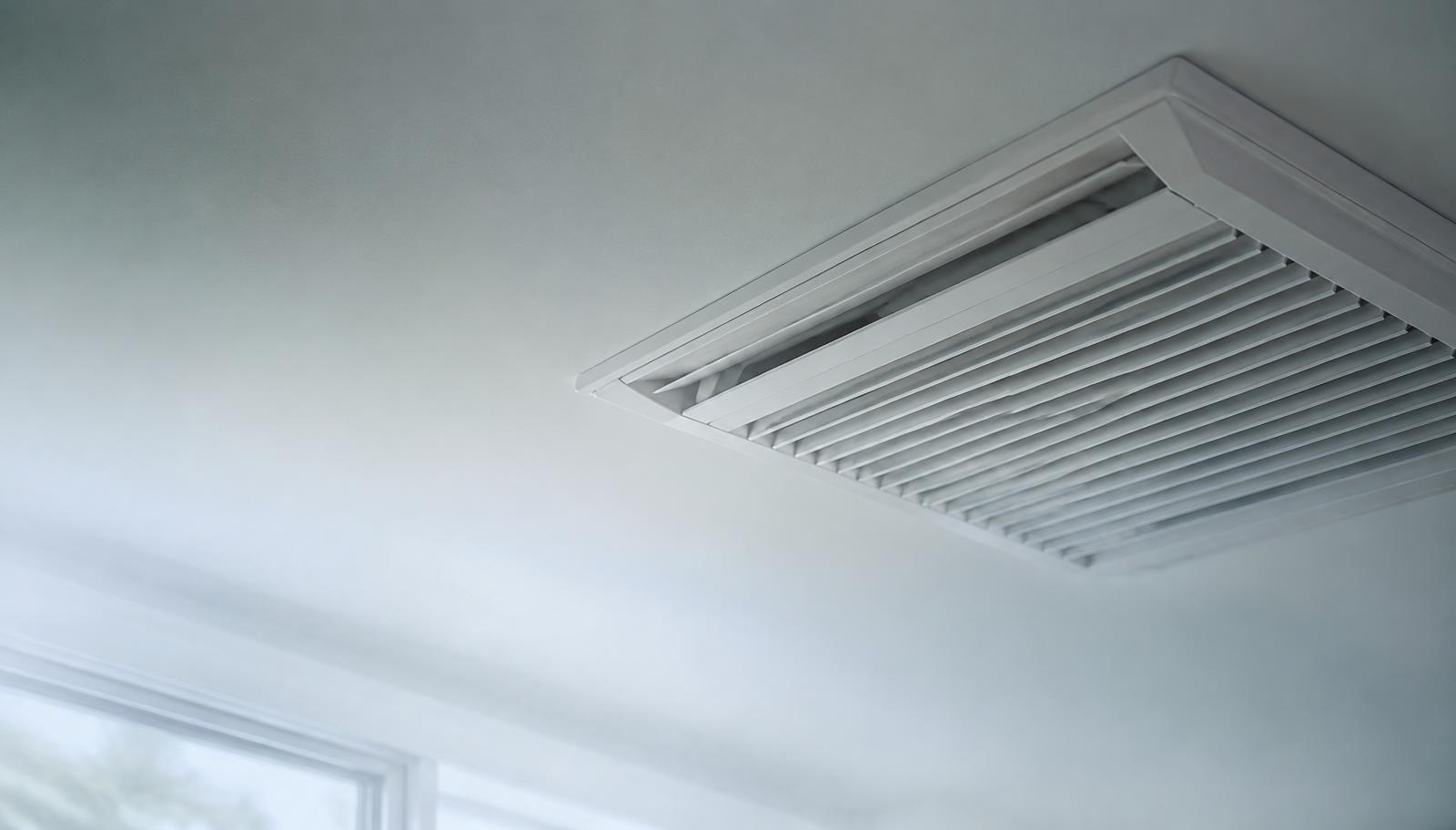
In commercial property management, mechanical settings dictate the environmental experience of a space. Building operators and facilities directors across New York City routinely audit heating, ventilation, and air conditioning (HVAC) schedules to balance comfort, mechanical wear, and energy performance. However, when introducing ambient scent into a commercial duct network, a standard climate control habit often undermines the entire installation: leaving the air handler fan on the AUTO setting.
Scenting through central air handling systems relies on precise fluid dynamics and continuous air movement. Understanding how cold-air diffusion interacts with mechanical ventilation clarifies why the AUTO setting leads to inconsistent results, and why keeping system fans set to ON is essential for uniform ambient coverage.
The Mechanics of HVAC Cold-Air Diffusion
To understand the conflict with the AUTO setting, one must examine how ducted scent delivery functions. Commercial HVAC scent delivery does not rely on evaporation, heat, or aerosolized propellant sprays. Instead, it utilizes cold-air diffusion.
In a cold-air diffusion system, liquid fragrance oil is converted into a dry micro-mist. This micro-mist is introduced directly into the supply ductwork of the air handling unit. Because the particles are microscopic and dry, they behave like a gas rather than an aerosol. They do not condense on interior duct linings, damp dampers, or mechanical filters. Consequently, there is no damage to the ventilation system.
Once injected into the airflow, the micro-mist is carried by the moving air supply and distributed evenly through the existing ceiling diffusers into the occupied zones below. The operational maintenance for this technology is minimal: the only maintenance required is replacing the fragrance oil bottle when it becomes empty. The delivery mechanism functions whether the climate system is operating in cooling mode, heating mode, or simply circulating unconditioned air with the fan setting. The single physical requirement for the system to distribute the scent is active, directional airflow.
Why the AUTO Setting Disrupts Scent Distribution
Most commercial thermostats and building management systems offer two baseline options for fan control: ON and AUTO.
When a thermostat is set to AUTO, the system fan engages only when the thermostat calls for heating or cooling. Once the room reaches its setpoint temperature, the compressor or heating element shuts down, and the blower fan powers off simultaneously. In a modern, well-insulated commercial structure, cycling off can leave the air handler stagnant for long stretches of time.
This intermittent operation introduces several immediate operational issues for ambient scenting:
- Inconsistent Scent Levels: When the fan turns off, scent delivery ceases entirely. Fragrance particles already in the room gradually disperse or exhaust through returns, causing the ambient scent level to drop. When the temperature shifts and the fan suddenly restarts, a concentrated burst of scented air enters the space.
- Air Stratification: Without consistent air movement, air within high-volume rooms stratifies. Scented air does not mix thoroughly across the floor plate, resulting in localized pockets where fragrance is noticeable alongside dead zones where it is absent.
- Loss of Fragrance Balance: Scent marketing relies on subtle, continuous background presence. Olfactory receptors adjust to steady, low-level inputs. When scent disappears and reappears unpredictably due to thermal cycling, occupants notice the abrupt change rather than experiencing a cohesive sensory environment.
Smell is processed by the limbic system, the part of the brain tied to mood, emotion, and memory. Because the limbic system responds directly to ambient environmental cues, maintaining a balanced olfactory profile is critical. Intermittent delivery caused by the AUTO setting disrupts this neurological consistency.
The Solution: Setting the Air Handler to ON
To achieve balanced distribution, the HVAC fan setting must be set to ON during business operating hours.
When the fan is set to ON, the blower runs continuously, maintaining positive pressure and constant circulation through the supply and return ducts. Heating and cooling elements still cycle on and off based on ambient temperature requirements, but the carrier stream of air never stops moving.
Continuous circulation provides several functional advantages:
- Uniform Dispersion: The dry micro-mist enters a constant stream of moving air, allowing it to travel through the duct network at predictable velocities.
- Precise Dosing: The diffusion equipment can be programmed to release micro-mist at steady, calibrated intervals matched to the continuous cubic-feet-per-minute (CFM) output of the air handler.
- Enhanced Environmental Stability: Continuous air movement prevents air pockets from settling and ensures that scent levels remain consistent from the start of the business day until closing.
In commercial settings such as retail spaces, consistent environmental delivery directly supports the customer experience. As noted in academic research, "People stay to examine products longer in stores with pleasing scented environments, increasing the likelihood of impulse purchases." (Vinitzky & Mazursky). Achieving that steady environment requires continuous airflow.
Airflow Volume and Physical Architecture
Air volume calculations dictate how scent moves through a commercial property. As detailed in our technical guide on ceiling height and commercial scenting, vertical volume alters the rate of air exchange and diffusion requirements within a zone.
When facilities feature high ceilings or open-plenum construction, leaving an air handler on AUTO exacerbates air stagnation. In tall spaces, warm air naturally rises toward the ceiling while cooler air remains near the floor. If the HVAC fan cycles off, the micro-mist can become trapped in upper air layers instead of reaching the breathing zone of occupants. Keeping the system fan engaged ensures mechanical destratification, pulling air through return grilles and circulating fresh, scented air down to ground level.
Options for Facilities Without Central Air
Not every commercial property has an accessible central air system with continuous fan controls. Older buildings, historic properties, or leased spaces with localized hydronic or ductless heating and cooling units require an alternative approach.
For these architectural layouts, standalone diffusers are available for spaces without central air. Standalone units utilize the same cold-air diffusion technology to atomize fragrance oil into a dry micro-mist. Rather than using ductwork for distribution, these units use internal blowers to project the scent directly into the room, relying on ambient indoor air currents to achieve uniform coverage.
Addressing Underlying Air Quality Issues
Scenting through an HVAC system should never be used to cover up maintenance deficiencies or building odors. Attempting to disperse a fragrance over stale or contaminated air produces an unpleasant sensory mix.
True ambient management incorporates odor neutralizing that eliminates unpleasant odors rather than masking them. For specialized industrial issues, trash rooms, or severe structural malodors, Zent works alongside sister brand Luften (luften.net), which provides commercial odor control at the source. For residential applications, sister brand Frave Home (fravehome.com) offers hotel-inspired home fragrance systems.
Engineering and Servicing Commercial Scent Systems
Integrating diffusion equipment with commercial HVAC machinery requires professional oversight to ensure equipment settings align with facility schedules. Zent uses a five-step approach to engineer and maintain commercial scent delivery:
- Initial Consultation: Assessing the layout, goals, and operational hours of the business.
- Facility Survey by the Engineering Team: A comprehensive, free site survey to review HVAC mechanical equipment, duct layout, airflow rates, and fan control settings.
- System Design: Selecting the appropriate cold-air diffusion units and specifying exact injection points within the supply ductwork.
- Scent Development: Formulating a custom signature scent developed with renowned perfume designers, or selecting a curated option from Zent's library.
- Installation, Monitoring, and Servicing: Executing the mechanical installation, performing on-site scent mapping to verify balanced coverage, assigning a dedicated Customer Care representative, and managing ongoing monitoring.
Zent supports facilities across New York City and the tri-state area, providing localized service to properties in Manhattan, Brooklyn, and commercial complexes across Queens. Clients choose from structured service plans based on operational needs, including Full Service, Value Service, and Get & Scent options.
All service plans include on-site and remote maintenance, support via email or a dedicated hotline, and a guaranteed 24-hour response time. Whether adjusting diffusion output to accommodate seasonal HVAC shifts or completing scheduled oil bottle replacements, professional monitoring ensures systems operate without manual intervention from building staff.
Auditing Your Air Handler Settings
If your facility experiences uneven fragrance levels, lingering scent pockets, or periods where ambient scent disappears entirely, start your troubleshooting at the thermostat. Verify that the fan switch is set to ON rather than AUTO during all operational hours.
For assistance with HVAC scent mapping, mechanical integration, or to schedule a free site survey for your building, contact the engineering team at Zent, call 212-222-0030, or email info@zent.nyc.